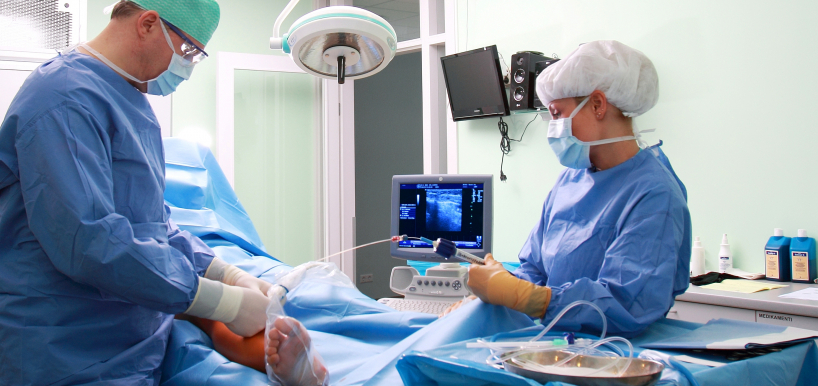

Nowadays, a vein operation only in rare cases means physically removing diseased veins through cuts in the skin. With the development of vein surgery, vein ablation — closing the veins using various minimally invasive techniques or their combinations (radiofrequency, laser, biological glue) — has become the standard.
After these procedures, the patient can immediately go home and resume usual daily activities on the same day or the next day. The foundation of successful treatment is selecting the right method.
| “Baltic Vein Clinic” provides the full range of the world’s recognised most modern and effective vein treatment methods and has become an example of personalised medicine. |
Vein surgery (or another treatment procedure) is necessary not only for cosmetic reasons. Most often it is performed when venous insufficiency causes symptoms, progresses, or leads to complications.
Leg swelling, especially in evenings
Feeling of heaviness in the legs, fatigue, pressure sensation
Pain or discomfort after long periods of standing or sitting
Night cramps
Itching, burning around veins
Visible varicose veins (bulging and twisted)
Vascular “spider veins” — often cosmetic but sometimes a sign of deeper venous load
If symptoms occur regularly or worsen, it may indicate progressive venous insufficiency.
Surgery or a procedure is more often necessary if the doctor detects the following during an ultrasound examination (duplex scan) or clinical evaluation:
Venous valve insufficiency (blood backflow, or reflux);
Large or progressively developing varicose veins;
Skin changes around the ankles (pigmentation, thickening, eczema);
Recurrent leg swelling;
Trophic ulcers or a risk of developing them;
Previous superficial thrombophlebitis;
Risk of blood clots or signs of thrombosis.
Vein treatment is especially important if:
There is skin damage or venous eczema;
There is recurrent inflammation in a vein (thrombophlebitis);
There is bleeding from the veins;
Non-healing wounds or ulcers appear;
The veins cause significant discomfort and limit daily activities.
In such cases, treatment helps not only improve appearance but also reduce the risk of complications.
One of the guiding principles of Veselības centrs 4 is the implementation of the concept of personalized medicine. There are no two identical patients — the same health problem may present differently and require different solutions. Each patient deserves treatment tailored specifically to them, both in terms of effectiveness and financial possibilities.
For this reason, we promote dialogue between patient and doctor — an open discussion about symptoms, lifestyle, available options, expected results, and possible complications.
Our specialists — vascular surgeons and phlebologists — determine the most appropriate type of vein surgery for each individual patient, selecting either a single method or a combination of methods. Most commonly, this is laser surgery combined with miniphlebectomy — a minimally invasive surgical procedure used to remove superficial varicose (dilated) veins.
When developing a treatment plan, both the patient’s health condition and secondary factors are taken into account — lifestyle, type of work, habits, mobility, physical and financial possibilities, and others.
We encourage patients, when choosing the type and location of surgery, to consider several recommendations.
Laser Surgery |
|
Vein Closure Using the VenaSeal™ Closure System |
|
Classical Vein Surgery |
|
Foam Sclerotherapy |
|
Transdermal Laser |
|
The surgeon should choose the method that is most suitable for you, not simply the only one available!
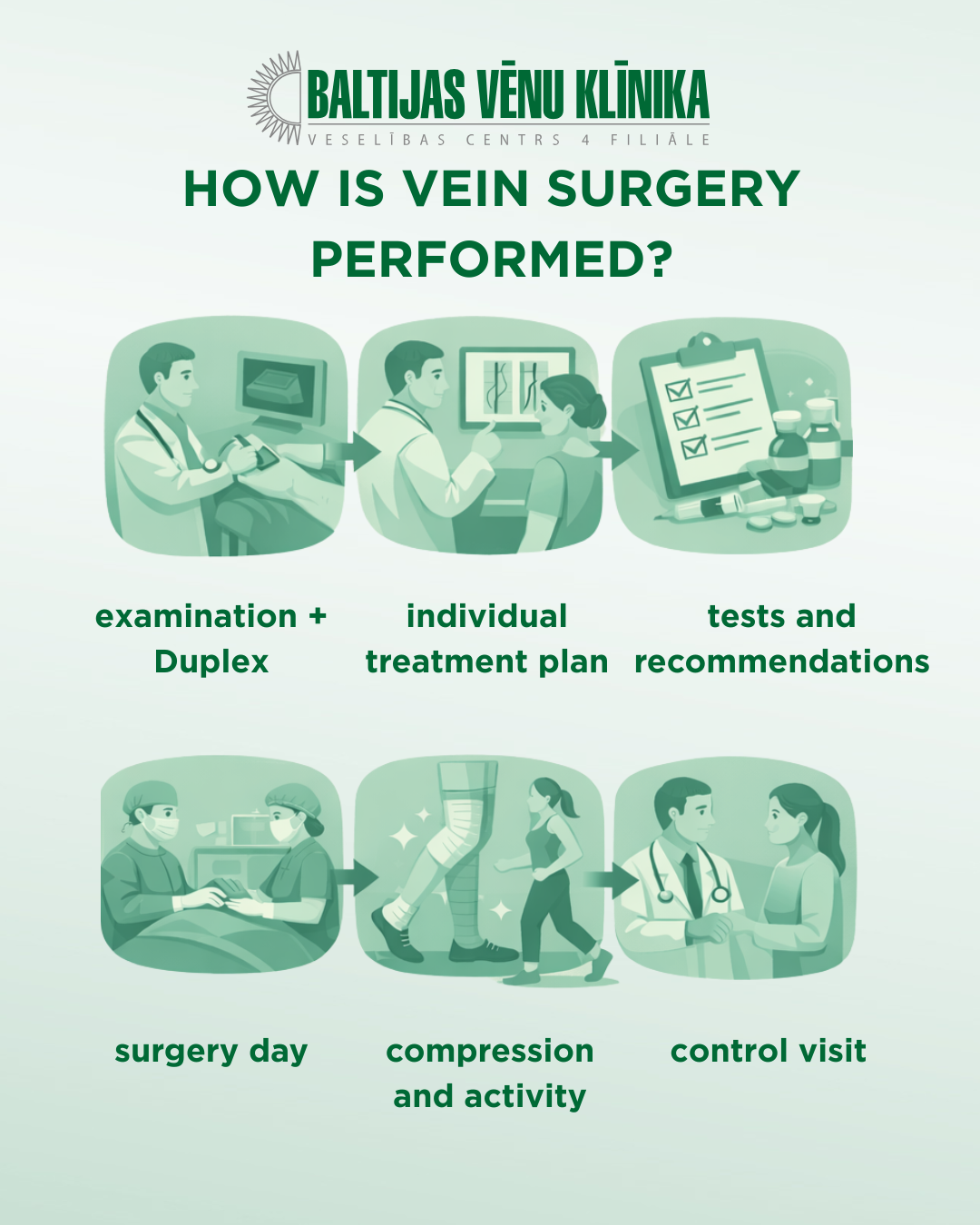
Before vein surgery, thorough diagnostics are essential in order to assess the condition of the veins, establish an accurate diagnosis, and choose the most appropriate treatment method. The diagnostic process helps ensure safe and effective treatment and reduces potential risks.
Diagnostics begin with a consultation with a phlebologist, during which the doctor:
collects a detailed medical history (information about complaints, symptoms, previous illnesses, surgeries, medications used, etc.);
identifies risk factors (heredity, lifestyle, type of work, etc.);
performs a visual examination of the leg veins and palpates them.
Usually, a venous duplex ultrasound examination is also performed during the consultation. This is a non-invasive, painless, and safe ultrasound method that allows the doctor to:
evaluate the condition of both deep and superficial veins;
determine the direction and speed of blood flow;
detect venous valve insufficiency;
accurately map the affected veins before surgery.
Duplex ultrasound is the main examination used when planning surgery. In most cases it is sufficient, however, in certain situations the doctor may prescribe additional tests.
Other examinations, such as angiography, segmental Doppler ultrasound, or CT phlebography, are prescribed less frequently and are usually not performed immediately during the consultation. They are only required in specific, more complex cases.
To ensure that preparation for surgery is clear and easy to understand, the patient is provided with a structured list of recommendations and requirements. This may include:
required laboratory tests (depending on the individual situation and the planned type of anesthesia);
an electrocardiogram (ECG), if necessary;
an opinion from the family doctor or other specialists in certain cases;
information on adjusting medication use before surgery;
recommendations regarding diet and fluid intake before the procedure;
information on purchasing and using compression stockings after surgery.
The exact preparation plan is tailored individually for each patient, taking into account their health condition and the chosen treatment method.
Thorough diagnostics and a clear preparation process are an important prerequisite for a successful vein surgery and faster recovery.
Vein surgeries can be performed under different types of anesthesia. The choice depends on the surgical method, the extent of the procedure, the patient’s health condition, and individual factors.
Modern technologies often allow surgery to be performed without general anesthesia, using local anesthesia instead. This is especially common in endovenous vein treatments (such as laser surgery or radiofrequency ablation).
During these procedures:
the anesthetic solution is injected around the vein under ultrasound guidance;
effective pain control is ensured throughout the treated segment;
the patient remains conscious and can return to daily activities more quickly after the procedure.
An exception is the biological glue (adhesive) method, where such extensive local anesthetic infiltration around the vein is usually not required.
Local anesthesia reduces the risks associated with general anesthesia and often allows for faster recovery.
Spinal anesthesia is administered by injecting an anesthetic into the lumbar region of the spine, temporarily blocking sensation and movement in the lower part of the body.
It is more commonly used in cases requiring more extensive or technically complex surgery, such as classical vein operations. The patient remains conscious during the procedure but does not feel pain in the surgical area.
General anesthesia means the patient is asleep during the operation and does not feel pain.
Classical vein surgeries are usually performed under spinal or general anesthesia, depending on the extent of the operation and the doctor’s recommendations.
The type of anesthesia is determined by the doctor after evaluating:
the planned surgical method;
the extent of the procedure;
the patient’s overall health condition;
existing comorbidities;
previous experience with anesthesia.
Before surgery, the anesthesiologist provides detailed information during a consultation about the selected type of anesthesia, how it will be administered, and safety considerations.
A modern approach allows, in most cases, effective and safe treatment with minimal anesthetic burden on the body.
| Patient Journey: From the First Consultation to Full Recovery Follow-Up:
|
Proper post-operative care after vein surgery is an essential part of treatment. It helps reduce the risk of complications, promotes faster recovery, and provides patients with confidence about the healing process.
Recommendations may vary slightly depending on the type of surgery, but there are several general principles that apply to most patients.
After endovenous procedures, patients are usually fitted with compression stockings (exception – the biological glue method).
Compression stockings:
improve blood return from the legs;
reduce swelling and discomfort;
lower the risk of thrombosis.
The stockings must be worn for the period specified by the doctor — this may mean continuous wear during the first days, followed by daytime use for a certain number of weeks.
The type of compression stockings required after surgery or other procedures is determined by the doctor. Medical compression stockings are designed to apply pressure at the ankle, which improves circulation and reduces leg swelling, pain, scarring, and skin changes (pigmentation, bruising, inflammation) after various vein surgeries.
When choosing compression stockings, the following factors should be considered:
Compression Level: Compression stockings come in different pressure grades, usually measured in millimeters of mercury (mmHg). For most people, mild to moderate compression (15–20 mmHg) is sufficient. Higher compression levels are recommended in specific medical cases or upon a doctor’s advice, such as deep vein thrombosis or other conditions.
Size and Fit: It is important to choose properly fitting compression stockings. Accurate sizing is essential for maximum effectiveness. For example, when selecting thigh-high stockings, the leg must be measured at five different points, usually by trained staff at the point of sale. Veselības centrs 4 offers digital 3D leg measurements to determine the precise stocking size for each patient individually. During digital measurement, the client stands on a rotating measuring platform that slowly turns while light beams project and capture measurements. In “DYNASTY” stores, we offer certified and customer-approved compression garments from leading manufacturers, including the German brands Bauerfeind and Bauerfeind Sports.
Style and Design: Compression stockings are available in various styles, lengths (knee-high, thigh-high, or tights), and colors. Choose a style that suits your preferences and lifestyle. Some models resemble regular everyday socks or sportswear elements, allowing you to combine functionality with style.
Unlike many other surgical procedures, movement should not be completely restricted after vein surgery — on the contrary, it is encouraged.
Walking is recommended as early as the next day. Regular walks promote blood flow in the deep veins and reduce the risk of deep vein thrombosis. International guidelines emphasize walking as one of the most important factors in reducing clot risk after varicose vein surgery.
During the first four weeks after surgery, it is recommended to:
avoid lifting heavy objects;
avoid intense strength training;
limit very high-intensity physical activity.
Daily activities and moderate walking are allowed and even encouraged.
Approximately one month after surgery, a follow-up duplex ultrasound is performed to:
evaluate the treatment results;
confirm vein closure (in the case of endovenous methods);
rule out possible complications.
In some cases, physical medicine procedures may be prescribed after endovenous surgery. These can usually begin about 7–14 days after the operation.
The course of treatment often consists of 10–18 sessions, depending on the patient’s condition and the doctor’s recommendations.
Contact your doctor immediately if you experience:
significant leg swelling or pain;
sudden redness or increased temperature in the surgical area;
shortness of breath or chest pain.
Remember! Modern vein surgeries are minimally invasive, and most patients quickly return to their usual daily routine. Regular walking, compression therapy, and following your doctor’s instructions are the key factors for a safe and successful recovery process.
Make sure that the price quoted by the clinic includes all expenses:
the cost of the surgery;
anesthesia;
the cost of materials;
stay at the clinic;
pre-operative and post-operative consultations;
compression stockings (some surgical methods do not require compression stockings).
In some clinics, all these costs are included in one total price; in others, they may appear as unpleasant additional charges after the surgery.
Please note — if you are offered participation in surgeries conducted within the framework of clinical trials, you should know that in Latvia and the European Union, clinical trials are free of charge, or the sponsor pays the patient for participation. Under no circumstances should a patient pay to participate in a clinical trial. All legally conducted clinical trials must be registered with the State Agency of Medicines (www.zva.gov.lv).
You can ознакомиться with consultation, surgery, and procedure prices at the Baltic Vein Clinic in the clinic’s price list.
We also offer deferred payment options in cooperation with our financial partners.
|
|
|
“NVD coverage” means that a medical service is fully or partially paid for by the National Health Service (NVD), provided that the patient has appropriate medical indications and a referral, and the service is received at a medical institution that has a contract with the NVD.
In practice, this usually means that the patient:
needs a referral from a family doctor or specialist;
must wait in line for a state-funded service;
may have to make a patient co-payment in accordance with national regulations.
Vein surgeries at the Baltic Vein Clinic are paid services. However, limited state-funded quotas are available for venous duplex ultrasound examinations and phlebologist consultations.
To apply for state-funded services at Veselības centrs 4 branches and group companies, you can call +371 67847100 or write to [email protected].
Ready to get rid of pain and heaviness in your legs? Don’t postpone taking care of your health. Modern leg vein surgeries are fast, safe, and involve a short recovery time. Book an appointment with the specialists at the Baltic Vein Clinic!
What vein surgery methods are available at the Baltic Vein Clinic?
The clinic offers both modern minimally invasive methods (EVLA, VenaSeal, miniphlebectomy) and classical surgery. The doctor selects the most suitable method after an individual ultrasound examination.
Is general anesthesia required for vein surgery?
Modern methods (EVLA, VenaSeal) are performed under local anesthesia; general anesthesia is not required. In cases of classical surgery, spinal anesthesia may be more appropriate. The doctor will explain the most suitable option.
How do I know if I need vein surgery?
Surgery is recommended if there are pronounced varicose veins with symptoms such as heaviness, swelling, leg pain, skin changes, or trophic ulcers. The first step is a consultation with a phlebologist at the Baltic Vein Clinic, including duplex ultrasonography.
How long is the recovery time after vein surgery?
With modern minimally invasive methods, recovery takes 1–5 days. Classical surgery requires a longer recovery period: 1–2 weeks. Compression stockings usually need to be worn for 2–6 weeks.
Can varicose veins return after vein surgery?
The treated veins do not return, but new varicose veins may develop over time. Regular check-ups and compression stockings for everyday use are recommended as preventive measures.
SIA "Veselības centrs 4" is one of the largest private multi-profile outpatient medical companies in Latvia with 30 years of experience and technologically advanced equipment. The main areas of operation include diverse diagnostics, full-spectrum treatment, modern rehabilitation, and a new concept of preventive and aesthetic medicine.